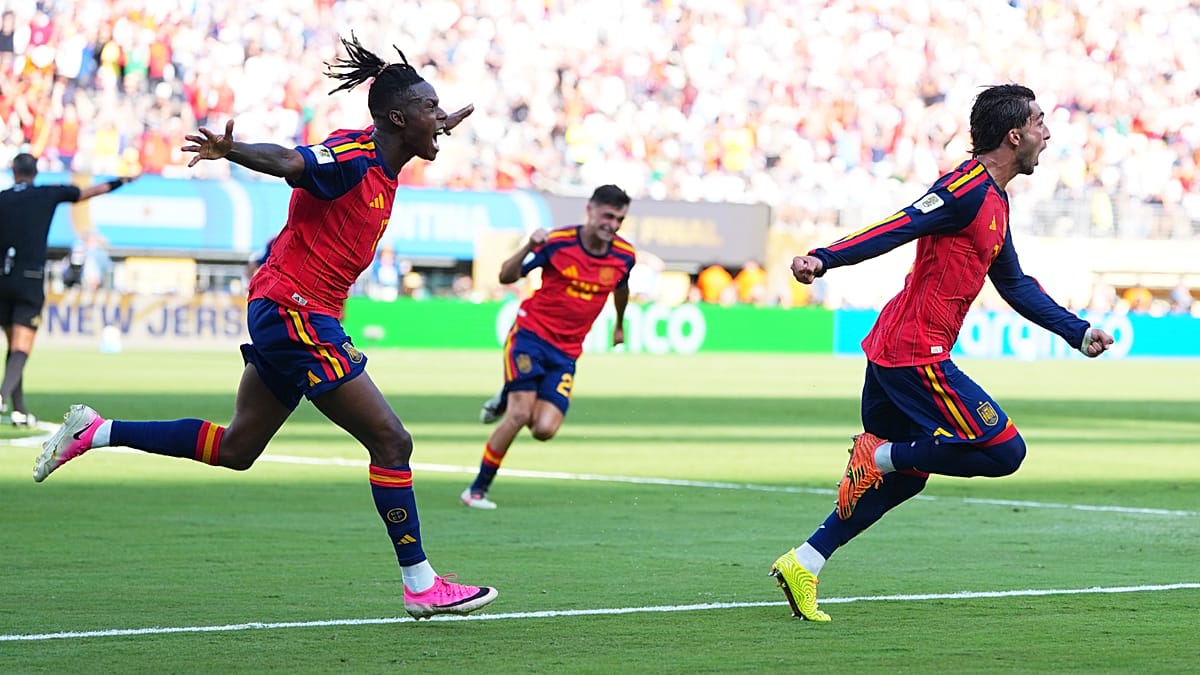
Spain Win the 2026 FIFA World Cup in Thrilling Final
Spain have been crowned world champions for the second time in their history after substitute Ferran Torres scored a dramatic extra-time winner to defeat defending champions Argentina 1-0 in the 2026 FIFA World Cup final at New York New Jersey Stadium on Sunday, July 19.
Luis de la Fuente’s side dominated the match from start to finish but were repeatedly denied by Argentina goalkeeper Emiliano Martinez, who produced a string of outstanding saves to keep Spain at bay for over 100 minutes. However, the Barcelona forward Torres proved the difference-maker in the 106th minute, reacting quickest to a loose ball in the penalty area and smashing home from close range to spark wild celebrations among the Spanish contingent.
A Final Worthy of the Occasion
The showdown between the reigning European champions and the defending World Cup holders lived up to every expectation. Played in front of a capacity crowd at the MetLife Stadium in East Rutherford, New Jersey, the match brought together the top two sides in FIFA’s world ranking, both of whom had arrived at the final unbeaten across the tournament.
Spain controlled the first half, creating the first notable chance through teenage sensation Lamine Yamal after just five minutes. The 18-year-old combined with Dani Olmo before forcing a sharp save from Martinez at the near post. Mikel Oyarzabal and Marc Cucurella both went close as Spain gradually tightened their grip on the game.
Argentina, led by the legendary Lionel Messi in what many believe was his final World Cup appearance, struggled to create meaningful chances against Spain’s well-organized defence. The physicality of the contest increased as the half wore on, with Argentina losing centre-back Lisandro Martinez to injury just before the break. He was replaced by Nicolas Otamendi.
Spain’s Dominance Continues in the Second Half
The pattern continued after the restart, with Spain dominating possession while Argentina relied on an aggressive press and quick counterattacks. Lionel Scaloni introduced Leandro Paredes to add steel to the midfield, but Spain’s technical superiority continued to shine through.
Substitute Ferran Torres headed straight at Martinez, while Pedri and Pau Cubarsi both tested the Argentina goalkeeper with powerful efforts. Aymeric Laporte also went close with a header from a corner as the pressure mounted. Despite Spain registering 20 shots over the course of the match, Martinez stood firm to keep his side in the contest.
Argentina Reduced to Ten Men
The game swung further in Spain’s favour when Argentina’s Enzo Fernandez received a second yellow card in stoppage time at the end of normal time, reducing the defending champions to ten men for extra time. Yet even with the numerical advantage, Spain needed a moment of inspiration to break the deadlock.
Extra time brought more of the same. Martinez kept out a header from Nico Williams and Mikel Merino fired an effort wide. Both Williams and Torres had goals disallowed for marginal offside calls, but Torres was not to be denied. When Nico Williams nodded down a Pedro Porro cross at the far post, Torres reacted instinctively, burying a first-time shot into the roof of the net.
Historic Achievement for Spanish Football
The victory marks Spain’s second World Cup title, following their 2010 triumph in South Africa when Andres Iniesta scored the winner against the Netherlands in extra time. This time, Ferran Torres etched his name alongside Iniesta in Spanish football folklore.
Notably, Spain conceded just one goal across the entire tournament — the lowest total for any World Cup-winning team in a single edition. With a defence marshalled by Pau Cubarsi and Aymeric Laporte, and goalkeeper Unai Simon in inspired form, Spain proved to be as resilient as they were creative.
What This Means for World Football
Spain’s triumph represents a changing of the guard in international football. The team that dominated world football between 2008 and 2012 has rebuilt under Luis de la Fuente, blending experienced campaigners like Rodri and Laporte with emerging talents such as Lamine Yamal, Pedri, and Nico Williams.
For Argentina and Lionel Messi, the defeat marks the end of an era. The 39-year-old, who led his country to glory in 2022, may have played his final game for the Albiceleste. The transition for Argentina will now begin, but their legacy as back-to-back Copa America champions and 2022 World Cup winners remains intact.
For neutrals, the 2026 World Cup has been a spectacular tournament — the first to be hosted across three nations (USA, Canada, and Mexico) and the first to feature 48 teams. The final was a fitting conclusion to a month of unforgettable football, showcasing the very best of the beautiful game.
Looking Ahead: The 2030 Centenary World Cup
Spain’s World Cup victory immediately turns attention to the 2030 tournament, which will be hosted jointly by Spain, Portugal, and Morocco to mark the competition’s centenary. As world champions, La Roja will enter that tournament as one of the favourites, with many of this squad expected to still be at their peak.
For now, however, Spanish fans can celebrate a truly remarkable achievement — a team that played brilliant, possession-based football, conceded just one goal in seven matches, and lifted the trophy in the most dramatic fashion imaginable.
Final Score: Spain 1-0 Argentina (AET)
Goal: Torres (106′)
Venue: New York New Jersey Stadium, East Rutherford
Player of the Match: Rodri (Spain)
—
Looking for expert analysis and the latest football predictions? At MK Sports, we bring you in-depth coverage of every major tournament, insider tips, and comprehensive betting markets. Whether you’re following the World Cup, Champions League, or Premier League, stay ahead of the game with MK Sports — your trusted partner for football insights and action.