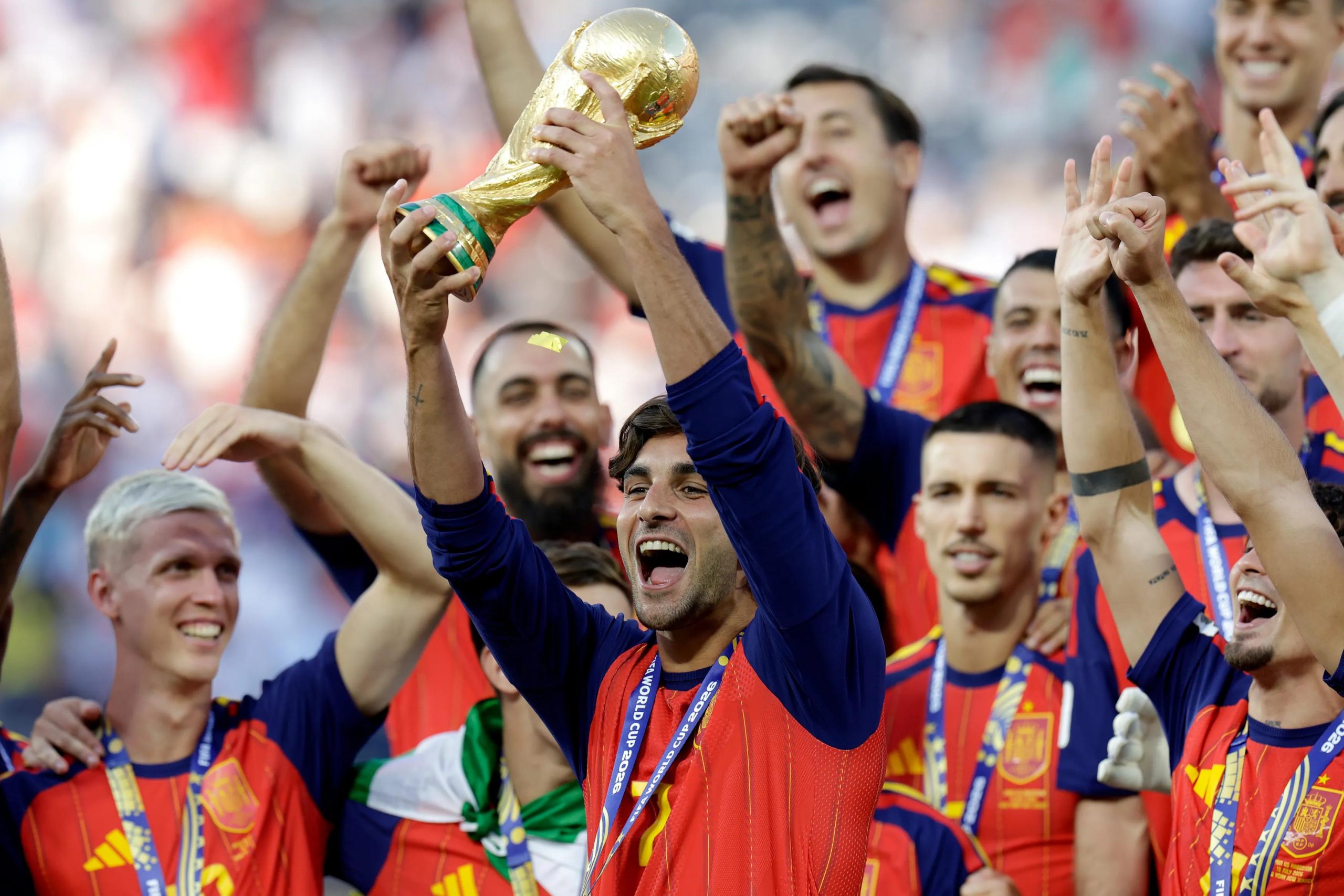
Spain Clinch Second World Title in Dramatic Final
In a final that will be remembered for generations, Spain defeated Argentina 1-0 in extra time at MetLife Stadium in New York New Jersey on July 19, 2026, to claim their second FIFA World Cup title. Super-substitute Ferran Torres wrote his name into Spanish football folklore with a clinical 107th-minute strike that broke Argentine hearts and sent the Spanish faithful into delirium.
The Build-Up: A Clash of Titans
The stage was set for an epic showdown. Spain, under the masterful guidance of Luis de la Fuente, had been the most consistent team throughout the tournament. Argentina, led by the legendary Lionel Messi in what many believe was his final World Cup appearance, had overcome every challenge thrown at them. The tension was palpable from the first whistle, with both teams exchanging early opportunities. Spain’s midfield trio controlled possession, while Argentina looked dangerous on the counter-attack through Messi and Julián Álvarez.
First Half: Tactical Chess Match
The opening 45 minutes were a tactical masterclass from both sides. Spain dominated possession with over 62%, but Argentina’s disciplined defensive structure, marshaled by Nicolás Otamendi and Cristian Romero, refused to yield clear chances. Lamine Yamal, the young Spanish sensation, came closest with a curling effort that brushed the outside of the post. At the other end, Messi nearly produced a moment of magic, but his free-kick sailed just over Unai Simón’s crossbar. The half ended 0-0, with both teams knowing the next goal could decide the World Cup.
Second Half: Drama Unfolds
The intensity ratcheted up after the break. Spain pushed forward with renewed purpose, and Argentina responded in kind. The game became an end-to-end thriller. In the 65th minute, the match took a decisive turn when Argentina’s Marcos Acuña received a second yellow card for a cynical foul on Nico Williams, reducing La Albiceleste to ten men. Despite the numerical disadvantage, Argentina defended heroically, with goalkeeper Emiliano Martínez producing a stunning save to deny Álvaro Morata from point-blank range. As the clock ticked towards 90 minutes, the game seemed destined for extra time.
Extra Time: Torres Seals the Deal
Fatigue began to set in during the first period of extra time, but the quality on display never wavered. Spain continued to probe, and Argentina continued to resist. Then, in the 107th minute, the moment arrived. Ferran Torres, introduced as a substitute just minutes earlier, latched onto a perfectly weighted through-ball from Pedri. With composure that belied the occasion, Torres cut inside past a desperate challenge and rifled a low shot into the far corner beyond Martínez’s reach. The Spanish bench erupted. The goal was a testament to Spain’s depth and de la Fuente’s tactical acumen — fresh legs making the difference when it mattered most.
What This Means for Football
Spain’s victory marks the continuation of a golden era for Spanish football. Following their 2010 World Cup triumph and three European Championships (2008, 2012, 2024), La Roja have once again proven they are a dominant force on the global stage. For Argentina, the defeat is a bitter pill to swallow. Lionel Messi, who turns 39 next month, may have played his final World Cup match. His legacy as one of the greatest players in history remains untarnished, but the fairytale ending eluded him. For Ferran Torres, the hero of the final, this goal cements his place in World Cup history. The Barcelona forward, who had struggled for consistent game time during the tournament, delivered when it mattered most — the hallmark of a true champion.
Tournament Highlights and Key Numbers
The 2026 World Cup, hosted across the United States, Canada, and Mexico, was the first 48-team edition and delivered unforgettable moments. Spain’s path to glory included a dominant group stage, a hard-fought quarterfinal victory over Belgium (2-1), and a commanding semifinal win against France (2-0). Argentina’s journey was equally impressive, with triumphs over Switzerland in the quarterfinals (3-1) and England in the semifinals (2-1). Key statistics from the final tell the story: Spain had 14 shots to Argentina’s 6, 65% possession, and completed 89% of their passes. The match was a fitting finale to a tournament that showcased the very best of international football.
Looking Ahead: The Future of International Football
With the 2026 World Cup now concluded, attention turns to the next cycle. Spain will look to defend their title at the 2030 centenary tournament, which will be co-hosted by Uruguay, Argentina, and Paraguay. For young stars like Lamine Yamal, Pedri, and Gavi, this is just the beginning. For the legends of the game — Messi, Cristiano Ronaldo, and others — the changing of the guard continues. One thing is certain: the 2026 World Cup final will be remembered as one of the greatest in history, a match that had everything — tension, drama, quality, and a moment of individual brilliance that decided the destiny of the most coveted trophy in sport.
Spain are world champions once again. Football is the winner.