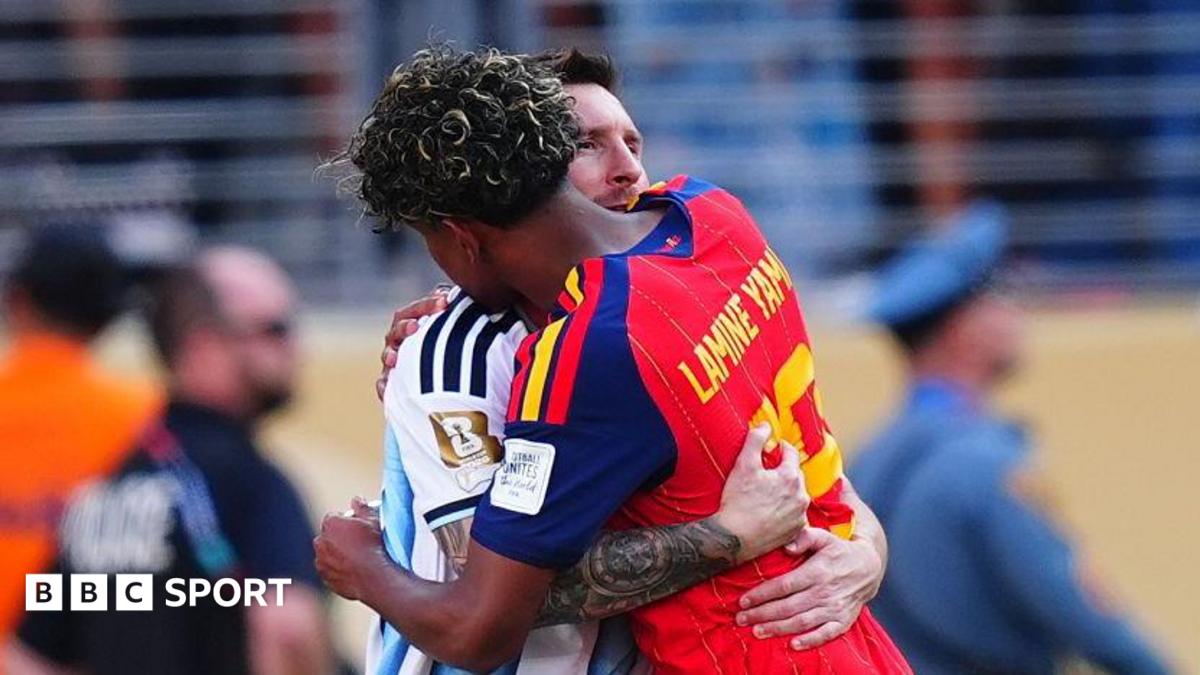
Historic Night at MetLife Stadium
In a gripping, tense 2026 FIFA World Cup final at MetLife Stadium in New Jersey, Spain emerged victorious with a 1-0 win over Lionel Messi’s Argentina, thanks to a stunning extra-time strike from substitute Ferran Torres. The goal, scored in the 106th minute, secured Spain’s second men’s World Cup title and cemented their place among the all-time greats of international football.
The match was a tale of Spanish dominance against Argentine resilience. Spain outshot Argentina a staggering 20-3 over the 120 minutes, but found Argentina’s goalkeeper Emiliano “Dibu” Martinez in world-class form. Martinez made an incredible 12 saves — the most ever recorded in a World Cup final — keeping Argentina in the game through wave after wave of Spanish attacks.
Dominance Without Reward
From the opening whistle, Spain controlled possession and created chance after chance. Lamine Yamal, the young Spanish sensation, caused havoc on the right flank, while midfield orchestrators Pedri and Rodri dictated the tempo. Argentina struggled to get out of their half, let alone create scoring opportunities.
In regulation time, Spain took 15 shots to Argentina’s zero. They earned nine corners to Argentina’s one. And yet, somehow, 90 minutes of complete domination wasn’t enough to break the deadlock. Martinez stood tall, making save after save, including a spectacular diving stop to deny a curling Yamal free kick from 22 yards out.
The match turned decisively in Spain’s favor when Argentina’s Enzo Fernández received his second yellow card in the third minute of second-half stoppage time for a reckless challenge that sent Spain defender Pau Cubarsi cartwheeling through the air. Argentina would play all of extra time with 10 men.
Torres Delivers the Moment
Just one minute into the second period of extra time, the breakthrough finally came. A bouncing ball fell in the box, and Ferran Torres — who had come on as a substitute in the 62nd minute — pounced. With his left foot, he smashed the ball just under the crossbar and past the despairing dive of Martinez. It was Torres’ first goal of the entire World Cup, and it could not have come at a more crucial moment.
“It was a goal scored by 47 million people,” Torres said after the match, referring to Spain’s population.
Spain’s defense deserves equal billing. La Roja allowed only one goal across all eight matches in the tournament, setting a World Cup record for the fewest goals conceded by a champion. Center-back pairing Pau Cubarsi and Aymeric Laporte were imperious, while full-backs Marc Cucurella and Dani Carvajal provided both defensive solidity and attacking width.
Record-Breaking Run
With this victory, Spain extends its unbeaten run to 38 matches (29 wins, 9 draws) — the longest such streak by any European team in history, surpassing Italy’s run of 37 matches from 2018-2021 that Spain themselves ended. The last team to beat Spain was… Italy, back in September 2021.
Spain also becomes the first nation to simultaneously hold the World Cup crowns in both men’s and women’s soccer, underscoring the golden era of Spanish football. Head coach Luis de la Fuente, at 65, became the oldest coach ever to lead a team to a World Cup title.
Argentina’s Heartbreak
For Lionel Messi and Argentina, the defeat was a bitter pill to swallow. The team that had been the king of late-game rallies throughout the tournament — producing dramatic comebacks in earlier rounds — had no answer this time. Messi’s final chance came from a corner kick in the dying minutes, but substitute Giuliano Simeone sent the ball high over the crossbar.
After the final whistle, there were heated exchanges, including Argentina’s Leandro Paredes appearing to grab a Spanish player by the throat. But cooler heads prevailed, and Spain’s players lined up to form an honor guard for Argentina to walk through on their way to collect runner-up medals.
A World Cup for the History Books
The 2026 tournament was the largest FIFA World Cup ever, featuring 48 nations competing across three host countries — the United States, Canada, and Mexico. More than six million fans attended matches during the 39-day tournament, which shattered attendance records and showcased the growing global passion for the beautiful game.
Spain’s triumph caps an extraordinary journey that began back in the group stage and saw them navigate past some of the world’s best teams. Their combination of technical brilliance, tactical discipline, and defensive resilience proved too much for even the most formidable opponents.
What This Means for Football
Spain’s victory signals the continued evolution of international football. While possession-based football has been Spain’s hallmark since their 2008-2012 golden era, this iteration of La Roja combines that technical foundation with a defensive solidity that borders on impenetrable. Their record of just one goal conceded in an entire World Cup campaign is unprecedented at this level.
For bettors and football enthusiasts alike, Spain’s dominance offers fascinating insights. The teams that combine technical quality with defensive organization continue to outperform at the highest level. As the football world looks toward the next World Cup cycle, Spain — with their blend of youth and experience, and their seemingly unbreakable unbeaten streak — will be the team everyone is chasing.
MK Sports Analysis
At MK Sports, we provide in-depth match analysis, real-time odds, and expert betting insights for all major football tournaments. Whether you’re analyzing Spain’s tactical setup, tracking player performances, or looking for the best pre-match and in-play betting opportunities, MK Sports has you covered with comprehensive coverage of the beautiful game.
Spain’s World Cup triumph is a reminder that in football, patience and quality always find a way. For the latest odds, expert predictions, and exclusive promotions on upcoming football fixtures, visit MK Sports today.